

Why do we snore?
During sleep the throat muscles relax; the tongue and soft palate fall back and narrow the airway. Air passing through the narrow space makes the tissues vibrate, which causes snoring. If the airway closes completely, breathing stops briefly; this is called sleep apnoea.
How does the appliance work?
It consists of two parts fitting the upper and lower teeth and holds the lower jaw a few millimetres forward. When the jaw comes forward, the base of the tongue comes forward too and the airway stays open. The amount of advancement is adjusted gradually at check-ups.
Who is it for?
It is considered for simple snoring and for people diagnosed with mild or moderate sleep apnoea by a sleep study whose sleep physician or ENT specialist recommends an oral appliance. In severe sleep apnoea the first choice is usually a positive airway pressure device (CPAP); for people who cannot use it, an appliance may be considered on the physician’s advice.
Who is it not for?
The appliance may not be suitable without enough healthy teeth, with advanced gum disease or with a marked jaw joint problem. That is why the teeth, gums and jaw joint are examined first.
Ready-made or custom?
Ready-made “boil-and-bite” mouthpieces sold online do not fit the teeth closely, their advancement cannot be adjusted and they may cause tooth or jaw joint pain. A custom appliance is made from your scan, is thin and adjustable, and is used under a dentist’s supervision.
Step by step
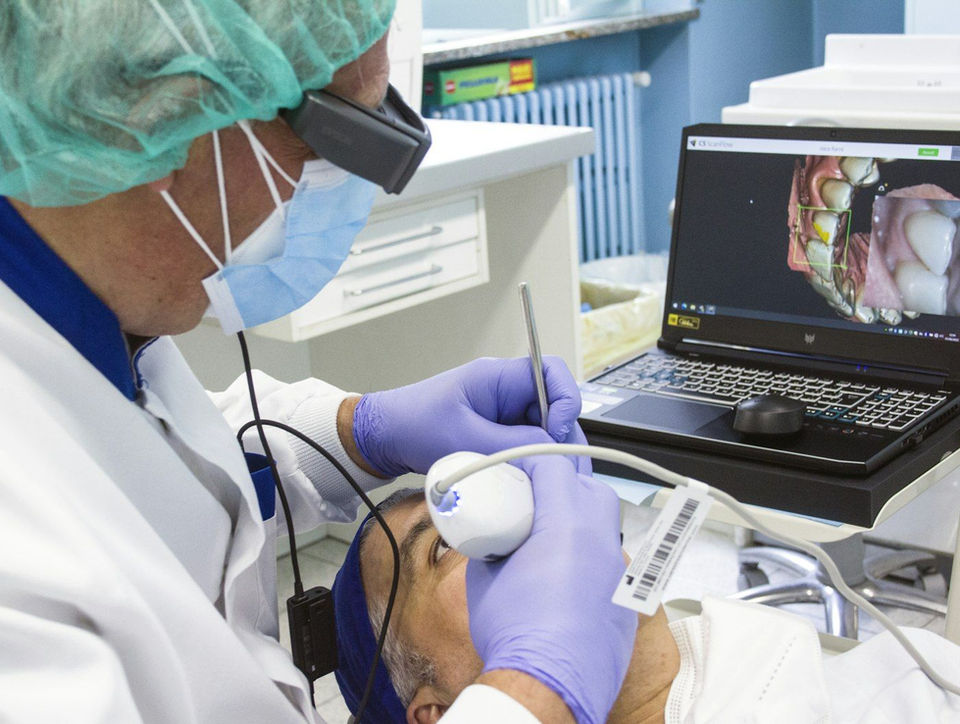
At the first visit you are examined, any sleep study you have is reviewed together, and your teeth are scanned digitally with iTero. When the appliance is ready it is tried in at the clinic and you are shown how to put it in, take it out and clean it. After the first weeks the jaw position is readjusted at a check-up if needed.
Getting used to it
In the first nights you may notice more saliva and mild tension in the teeth and jaw in the morning that passes; most people adapt within a week or two. Your dentist will show you short jaw exercises for the morning.
Follow-up
The effect is assessed with your sleep physician based on how your symptoms change and, when needed, a repeat sleep study. Teeth and jaw joint are checked at least once a year.
Frequently asked questions
Does a snoring appliance stop snoring completely?
For many people it reduces snoring clearly; the result depends on the cause of snoring and the shape of the airway.
Is it enough on its own for sleep apnoea?
It is one treatment option for mild and moderate sleep apnoea; the decision is made with a sleep physician based on the sleep study.
Can it harm my teeth or jaw?
With a custom, correctly adjusted appliance the risk is low. Small changes in the bite can occur with long-term use, so regular check-ups are recommended.
Is a snoring appliance the same as a night guard?
No. A night guard protects against clenching and grinding; a snoring appliance holds the lower jaw forward to open the airway.
Is it uncomfortable to sleep with?
It feels unfamiliar in the first nights; custom appliances are thin, so most people adapt quickly.
How long does it last?
It depends on use and care; wear and fit are assessed at check-ups.
Are appliances used for snoring in children?
In children snoring is often caused by adenoids, tonsils or a narrow upper jaw; an ENT and orthodontic assessment comes first.