
Digital impressiona 3D impression taken with an intraoral scanner, without impression paste
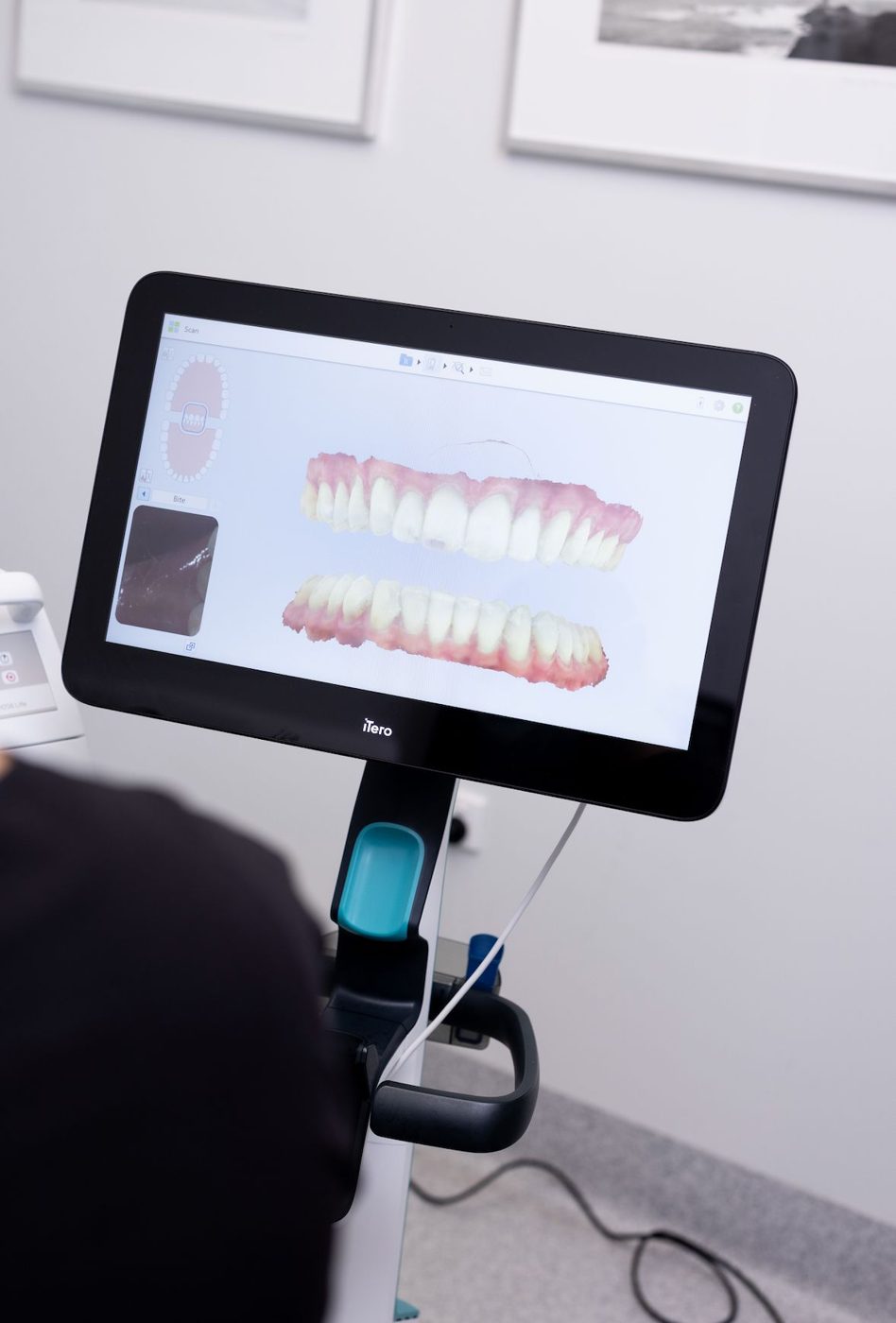
A digital impression means scanning the teeth and gums in 3D with a small, camera-like device called an intraoral scanner and turning the scan into a virtual model on a computer. The paste, tray and plaster used in the conventional impression are not needed; the model is seen on screen immediately and is used in planning orthodontics, clear aligners, crowns and implants.
At the clinic, the digital impression is taken with iTero. With the scan, the orthodontist shows the predicted result on screen in clear aligner treatment; during treatment the scan can be repeated to compare progress.
- Who is it not suitable for?
- A digital impression does not replace imaging: X-rays or CT are needed for roots, bone and impacted teeth. Scanning can be more difficult in situations such as heavy gum bleeding, excess saliva or limited mouth opening, and if needed a conventional impression or an additional scan is made. For some types of prostheses and in a toothless mouth, the conventional method may still be necessary.
- How many visits, and how long does it take?
- Scanning one jaw usually takes a few minutes; the total time varies with the structure of the mouth, the child's cooperation and the number of areas to be scanned.

Who is it suitable for?
A digital impression is most often used in the following situations:
Whether it is suitable for you is determined after an examination.
How is a digital impression taken?
The teeth are gently dried; the tip of the scanner is moved slowly over the chewing surfaces and the inner and outer faces of the teeth. The device captures many images per second and combines them to create a 3D model of the mouth. When the scan is finished, the model is rotated and enlarged on screen and examined together; if an area is missing, only that area is scanned again, and the whole impression does not need to be repeated.
The animation is illustrative; every patient's treatment plan is different.
Treatment step by step
- PreparationThe area to be scanned and the purpose are determined; the teeth are dried.
- Upper and lower jaw scanThe scanner is moved slowly over all surfaces of the teeth.
- Bite registrationHow the upper and lower teeth fit together on closing is also scanned.
- Review on screenThe 3D model is examined together; if needed, a missing area is scanned again.
- PlanningThe clear aligner, appliance or restoration plan is prepared in the digital environment.
- Follow-up scansProgress during treatment can be compared with new scans.
Duration and number of visits vary from person to person.
Digital impression or conventional impression?
| Digital impression (iTero) | Conventional impression (paste) | |
|---|---|---|
| Method | 3D scan with a camera-like scanner | A mold is taken with a tray and paste |
| Comfort | No paste taste or gagging sensation; found more comfortable by most patients | Paste, tray and waiting time can cause gagging |
| Time | Generally shorter; chair time is often reduced | The paste has to be left to set |
| Correction | The missing area is scanned again | If there is an error, the impression is retaken from the start |
| Model | Instantly on screen; stored and shared digitally | Poured into a plaster model, needs storage space |
| Accuracy | Scientific reviews report results comparable to the conventional impression; not the same in all cases | The standard method used for many years |
| Limitation | May be difficult with very extensive tooth loss and with some prostheses | May be difficult in children with a gag reflex and in young children |
Free pre-assessment
If you live abroad, we can review your case remotely before you plan your trip.
- Send photos of your teeth and a recent X-ray, if you have one, via WhatsApp.
- Our dentist reviews them and tells you the likely treatment options and how many days you should plan.
- We agree on dates together; the final plan is made at the examination in our clinic.
Sources
- Clinical aspects of digital three-dimensional intraoral scanning in orthodontics: A systematic review. Saudi Dent J, 2023
- Intraoral Scanners in Orthodontics: A Critical Review. Int J Environ Res Public Health, 2022
- Intraoral scanning reduces procedure time and improves patient comfort: a systematic review. Clin Oral Investig, 2021
Frequently asked questions
A short introduction to our clinic.
What is a digital impression?
It is the scanning of the teeth and gums in 3D with an intraoral scanner and turning the scan into a virtual model on a computer. Impression paste and a tray are not used.
Is a digital impression more accurate than a conventional impression?
Scientific reviews report that intraoral scanning gives results comparable to the conventional impression in orthodontics, but that accuracy varies with the device, the scanning method and the case. The most important gains are patient comfort, speed and ease of digital work.
How long does a digital impression take?
It usually takes a few minutes for each jaw; the total time, including the upper jaw, lower jaw and bite registration, varies with the structure of the mouth and the area to be scanned.
Does a digital impression hurt or cause gagging?
It does not cause pain. Because no paste is used, it is generally more comfortable for patients and children with a gag reflex; still, as the scanner tip moves around the mouth, mild discomfort may be felt.
Does a digital impression involve radiation?
No. The intraoral scanner works on visible light and camera principles; it does not use ionizing radiation as X-rays or CT do.
Does a digital impression replace an X-ray?
No. The scan shows the surface of the teeth and gums; X-rays or CT are needed for roots, bone and impacted teeth.
Is a digital impression mandatory for clear aligners?
The Invisalign plan is prepared from an iTero scan. The digital model is used to produce the aligners and to show the predicted result.
Can digital impressions be taken in children?
Yes, in children who can cooperate. Because it is short and contains no paste, it is comfortable for children; if cooperation cannot be achieved at a young age, the impression can be postponed to another session.
Which treatments use a digital impression?
It can be used in treatments such as clear aligners, retainers, palatal expanders and some functional appliances, crowns, veneers, bridges, implant-supported prostheses and night guards.
Is there a charge for a digital impression?
The digital impression is mostly done as part of the treatment package; for details you can see our Prices page or call us.
Is it right for you? Let's talk at your examination.
We listen to your concerns and expectations, and after the examination we review the options together.