
Twin Block appliancea removable functional appliance that corrects a retruded lower jaw in growing children
The Twin Block is a two-piece, removable functional appliance worn on the upper and lower jaw, used in growing children and adolescents when the lower jaw is set back (Class II). The two acrylic blocks fit together on closing and guide the lower jaw forward; as the child closes their mouth, the lower jaw comes to a more forward position, and jaw growth and tooth position are influenced in this direction.
Its effect is more pronounced when it is applied while growth continues in children. At the clinic, the Twin Block is planned after the orthodontist's examination, lateral cephalometric radiograph and photographic records; afterwards most children need a fixed braces or clear aligner phase.
- Who is it not suitable for?
- The Twin Block is meaningful only in children and adolescents who still have growth potential; in adults whose growth is complete it does not bring the lower jaw forward, and for adult Class II cases options such as clear aligners, fixed braces or jaw surgery are discussed. An appliance that is not worn regularly has no effect; the child's compliance directly determines success.
- How many visits, and how long does it take?
- The appliance is usually actively worn for 9-12 months in growing children; a retention phase may then be needed for a period. The duration varies with the case and the child's compliance.

Who is it suitable for?
The Twin Block is most often planned in the following situations:
Whether it is suitable for you is determined after an examination.
How does the Twin Block work?
The appliance consists of two acrylic plates that sit separately on the upper and lower jaw; the inclined blocks on the plates fit together as the child closes their mouth so that the lower jaw slides forward. As the lower jaw takes up this forward position, the surrounding muscle and bone structures adapt to it. While growth continues, this adaptation influences the development of the lower jaw and the position of the teeth in the planned direction.
The animation is illustrative; every patient's treatment plan is different.
Treatment step by step
- Examination and recordsFacial profile, bite and jaw joint are assessed; a lateral cephalometric radiograph, panoramic radiograph and photographs are taken.
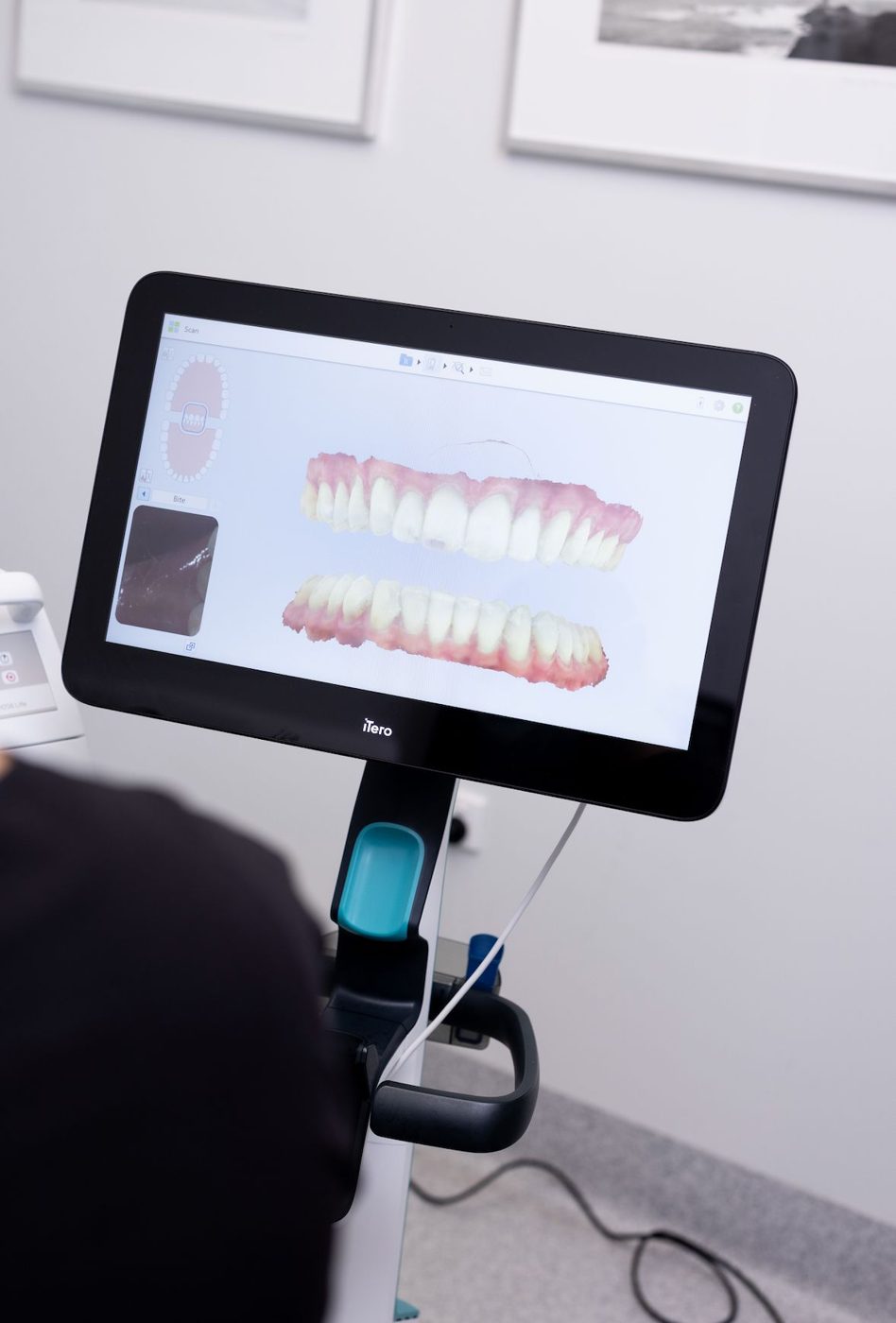
- Digital or conventional impressionAn impression of the mouth is taken for the appliance; where possible, a digital scan with iTero is used.
- Bite registrationThe target position of the lower jaw is determined and the appliance is made in the laboratory accordingly.
- Delivery of the applianceThe appliance is tried in; insertion, removal, cleaning and daily wear time are explained to the child and the family.
- Check-upsProgress is monitored at regular intervals; the blocks are adjusted.
- Transition to fixed treatmentOnce the jaw relationship is corrected, if needed the treatment moves on to a braces or clear aligner phase to align the teeth.
Duration and number of visits vary from person to person.
Twin Block or other functional appliances?
| Twin Block | Fixed functional appliance (Herbst, Forsus, etc.) | |
|---|---|---|
| How it is worn | Removable, two pieces | Fixed to the teeth |
| Compliance | The child must wear it regularly | Independent of patient compliance because it cannot be removed |
| Cleaning | The appliance is removed and brushed | Special cleaning is needed around the appliance |
| Eating and speaking | Removed for meals; speech may be affected in the first days | Eating and speaking may be affected continuously |
| Period of use | Children and adolescents who are still growing | During or after the growth period, depending on the case |
| Evidence | There are many studies and reviews; skeletal and dental effects are generally reported | There are studies reporting similar skeletal and dental effects; effects vary by appliance |
Free pre-assessment
If you live abroad, we can review your case remotely before you plan your trip.
- Send photos of your teeth and a recent X-ray, if you have one, via WhatsApp.
- Our dentist reviews them and tells you the likely treatment options and how many days you should plan.
- We agree on dates together; the final plan is made at the examination in our clinic.
Sources
- Skeletal and Dental Effects of Forsus FRD vs Twin Block Appliance for Class II Malocclusion in Growing Patients: A Systematic Review. Clin Exp Dent Res, 2024
- Herbst and Twin Block appliances in the treatment of Class II malocclusion in children: meta-analysis (PMC10895725)
- Effects of a Twin-block appliance on the condyle in Class II malocclusion: systematic review and meta-analysis (PMC10372524)
Frequently asked questions
A short introduction to our clinic.
What is a Twin Block appliance?
It is a two-piece, removable functional appliance worn on the upper and lower jaw, used in growing children and adolescents when the lower jaw is set back (Class II). It is used to guide the lower jaw forward.
At what age is the Twin Block used?
Its effect is more pronounced while growth continues, mostly in children before or at the beginning of puberty. The orthodontist determines the right timing by looking at the child's growth status.
Is the Twin Block worn all day?
It is an appliance that is usually recommended to be worn most of the time except during meals, sports and brushing; the recommended duration varies by doctor. If it is not worn regularly, the effect decreases.
For how many months is the Twin Block used?
The active phase is usually around 9-12 months; it may be longer depending on the child's compliance and the case. A retention phase follows, and most children need a second phase to align the teeth.
Does the Twin Block hurt, does it affect speech?
In the first days there may be difficulty chewing and speaking, a slight lisp and increased saliva; most children get used to it within a few days. If there is a sore or severe pain, call the clinic.
Does the jaw really move forward with the Twin Block?
Studies report an increase in jaw length and in lower jaw position in children of a suitable age; part of this effect is a dental change and it is not the same amount in every child. For this reason no guarantee is given about results.
Is the Twin Block used in adults?
In adults whose growth is complete, no effect of bringing the lower jaw forward is expected. For adult Class II cases, options such as clear aligners, fixed braces or jaw surgery are discussed.
Can Herbst or Forsus be used instead of the Twin Block?
These appliances are fixed and work independently of the patient's compliance. Because the Twin Block is removable, it requires the child's cooperation; which one is suitable is decided at the examination.
Does the Twin Block affect sleep apnea or breathing?
Some studies report an increase in the upper airway after treatment, but this is not a treatment for sleep apnea. If there is snoring or a sleep problem, consulting an ear, nose and throat doctor is recommended.
How is the fee determined?
The fee is determined at the examination according to the treatment plan.
Is it right for you? Let's talk at your examination.
We listen to your concerns and expectations, and after the examination we review the options together.